

- AHRS, Auto Pilot, Demo, G4, Servo, Synthetic Vision, Terrain, UPC
- Evan Flatt
MGL Avionics August 2026 Update
MGL Avionics August 2026 Update: New Hardware, Major G4 Improvements, and Lower Autopilot Pricing
Oshkosh 2026 was a success and August brought several significant updates from MGL Avionics, ranging from new hardware announcements and G4 software developments to a lower price on the MGL autopilot servo. MGL is also expanding the options available for integrating both new and legacy avionics.
Here’s a look at what’s new.
Coming Soon: An Updated AHRS — An Important Step Forward
For many MGL users, the AHRS has been one of the weakest parts of the overall system experience.
Previous generations generally worked well in favorable installations, but some users experienced attitude instability, drift, vibration sensitivity, or performance that simply did not meet expectations. These issues were especially frustrating because the EFIS itself could be highly capable while the quality of the displayed attitude information ultimately depended on the AHRS feeding it.
MGL is addressing that directly with a substantially redesigned AHRS device.
The new design combines much higher-quality inertial sensors with significantly more capable processing, targeting several of the specific limitations that affected previous generations.
At the center of the new AHRS is a higher-end Inertial Measurement Unit (IMU). The sensor is considerably more expensive than the devices used in earlier MGL AHRS products, but it provides a substantially better foundation for accurate attitude determination.
The processing architecture has also changed significantly. Previous SP-7 and SP-9 systems operated at roughly 40 to 100 samples per second, depending on the system. The new AHRS processes inertial data at 500 samples per second. That higher update rate gives the algorithms much more information to work with and allows substantially faster filtering and correction.
Processing is now performed using double-precision mathematics, helping reduce numerical errors and long-term drift inside the attitude solution.
Another important improvement is the gyroscope calibration process. Earlier MGL designs required an in-house calibration procedure to characterize the sensors. That process was time consuming and introduced another opportunity for variation between individual units. The new gyro sensors are factory calibrated by the manufacturer, removing much of that uncertainty and manual labor from the production process.
The real test will ultimately be how the new AHRS performs across a wide range of aircraft and installations. We are looking forward to getting the updated units into aircraft and seeing the results in real-world operation outside of the MGL test aircraft.
Pricing and lead-time information is expected in fall 2026.
G4 Terrain and Synthetic Vision Have Gotten a Major Overhaul
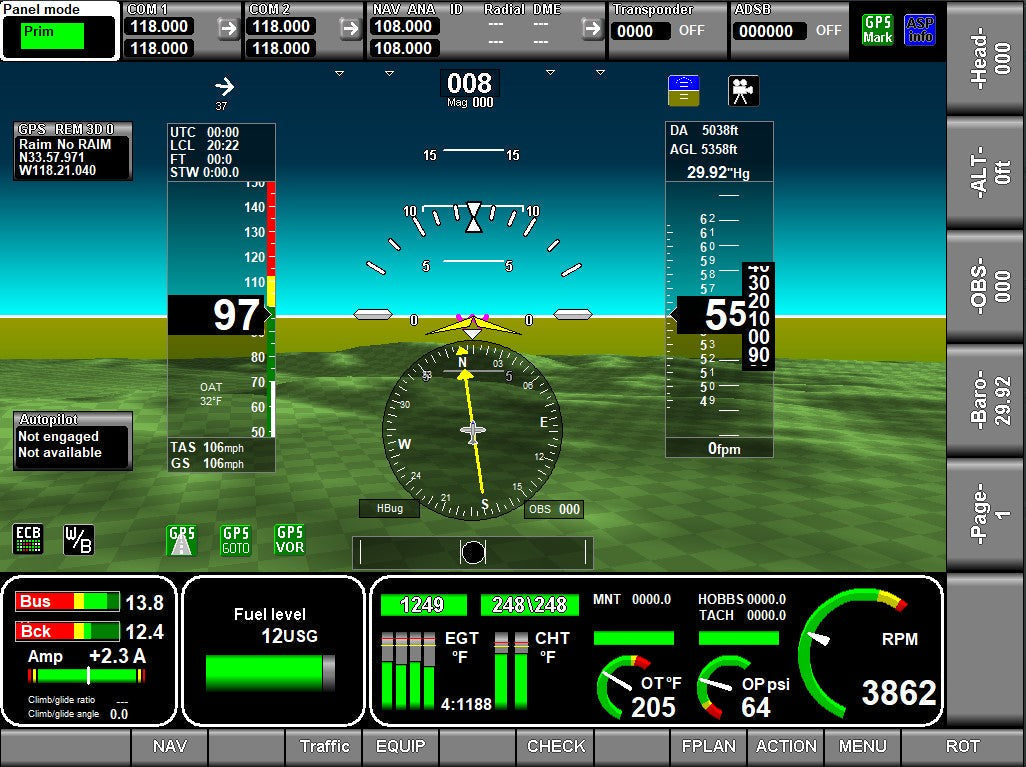
MGL has addressed several issues in the previous G4 synthetic-vision system with a substantial overhaul of the terrain-rendering system. High- and low-resolution terrain data can now be displayed simultaneously up to 2,000 feet AGL, allowing the system to retain greater detail nearby while still displaying a much larger surrounding area.
A bug that could cause terrain misalignment has also been addressed, and checkerboard terrain shading has been changed so that the pattern remains at a consistent scale as the terrain resolution changes.
For pilots, the end result should be a smoother, less jarring depiction of the world outside the aircraft—particularly when operating around rising terrain or when flying at varying altitudes.
This remains an area of active G4 development. The transition between the high- and low-resolution terrain regions is not yet perfect, and we expect additional refinement in future firmware releases.
You can download the latest G4 firmware from MGL's website here.
Demo Mode Got A Bit More Useful
As part of testing for the new terrain visualization, it became useful to have a simulator-type function in the iEFIS.
Now demo mode allows you to set a starting latitude/longitude and fixed ground speed. You can adjust heading and altitude with the heading and altitude bugs.
Coming Soon: MGL Universal Protocol Converter
Perhaps the most interesting new hardware project is an upcoming MGL Universal Protocol Converter (UPC).
Experimental aircraft panels increasingly contain equipment from several generations and manufacturers. One device may communicate over CAN bus, another over RS-232, and another may use an entirely different data format. Even when two devices contain all of the information needed to work together, incompatible communication protocols can prevent them from doing so.
Importantly, this new device will allow ARINC connections for Lite systems, completely bridging the gap in functionality between Lite and Full systems with iBOX. MGL Lite systems will be able to operate identically to complex iBOX systems through the use of optional external modules.
Rather than creating a dedicated interface box for every possible combination of equipment, the concept is a flexible device capable of receiving data in one supported format and translating it into another.
That opens up some interesting possibilities for both new installations and upgrades to existing aircraft. It could make it easier to integrate third-party equipment with an MGL panel, connect newer avionics to older equipment, or solve unusual integration problems without requiring a completely custom hardware solution.
We’ll share supported interfaces, protocols, configuration options, pricing, and availability as the project gets closer to release.
Coming Soon: "Voyager 2" 10.1" EFIS
The legacy G1/G2 Voyager is being reimagined as a new G4 system.
With a 10.1", 1024x600, 5:3 display, the Voyager 2 could make a great addition to many panels that cannot fit the tall screen format of the Challenger.
Importantly, the new housing material will be upgraded to an improved nylon. This should significantly improve to the strength and durability of the EFIS housing.
MGL Autopilot Servo Price Reduced
There is also some good news for anyone planning an MGL autopilot installation.
The MGL digital autopilot servo is now $875 through Legit Avionics.
Because the autopilot functionality is built into the MGL EFIS, adding an MGL autopilot does not require purchasing a separate autopilot control computer. For aircraft already equipped with an MGL EFIS, that can make a two- or three-axis autopilot a particularly attractive upgrade (especially when the new AHRS becomes available).